RTO Ceramic Media Replacement: When to Do It and What Waiting Costs You
The ceramic media beds inside your regenerative thermal oxidizer are the reason the machine is economical to run at all. They capture heat from the outgoing clean air and return it to the incoming process air, which is how a well-running RTO achieves 95%+ thermal energy recovery and burns very little supplemental gas. When the media degrades (plugs, breaks down, channels, or fouls), the RTO does not stop working. It just quietly starts costing you more every month, until one day it costs you a shutdown or a compliance event.
That is what makes media replacement a genuinely hard call for plant and maintenance leaders: there is no failure light. The unit still makes temperature, the permit parameters still read in range, and the changeout is a real outage with a real price tag. Here is how to make the decision with numbers instead of guesswork.
What RTO Media Actually Does, and How It Dies
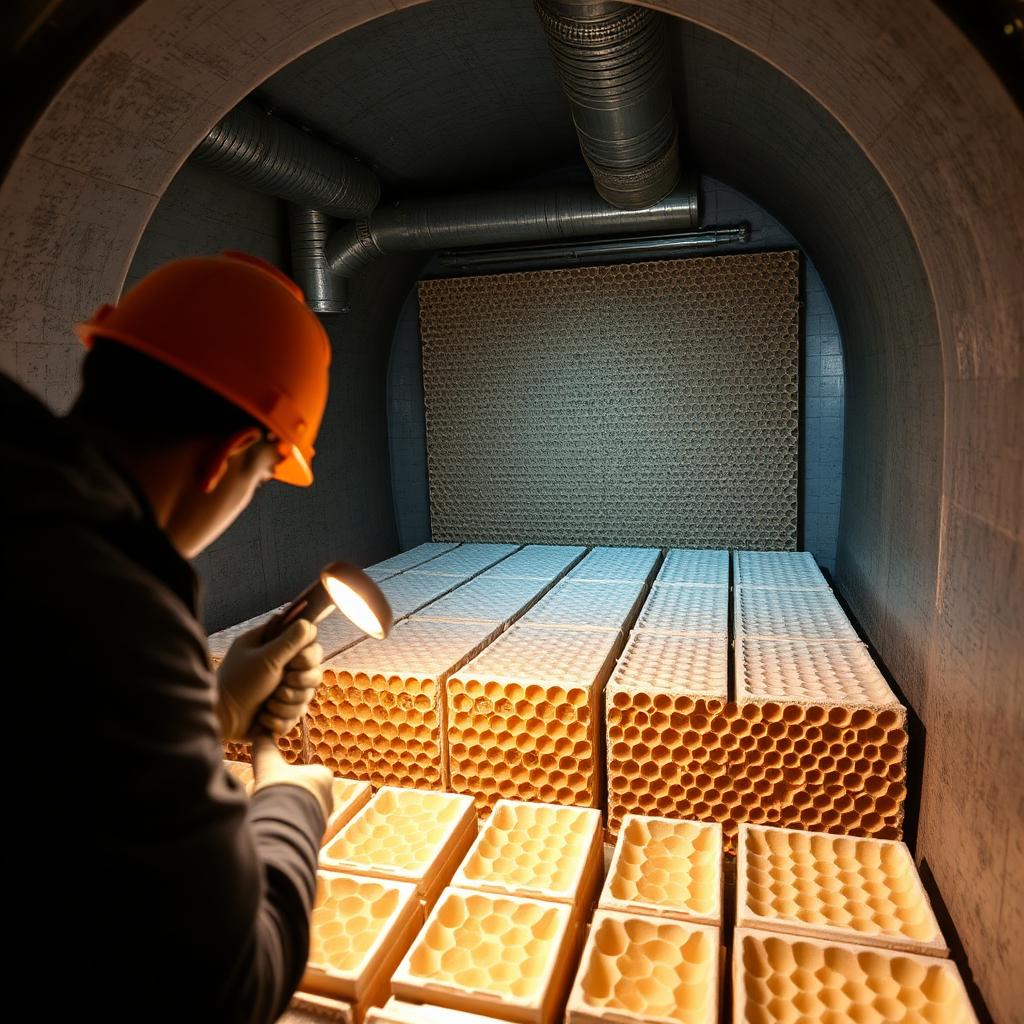
Most RTOs run either structured monolith blocks (honeycomb-style, low pressure drop, high heat transfer) or random packing (saddles, typically more tolerant of particulate but with higher pressure drop). Either way, the media lives a hard life: thermal cycling every time flow valves switch, temperatures near 1,500°F (815°C) at the hot face, and whatever your process sends it.
Media degrades through a handful of mechanisms, and knowing which one you have changes the fix:
- Plugging and fouling: particulate, condensed organics, resins, and salts accumulate in the cold face and lower passages. Common in coating, wood products, food processing, and any process with aerosol carryover. Silicone compounds are especially brutal: they convert to silicon dioxide in the bed and permanently glaze the media.
- Thermal degradation and breakage: repeated cycling cracks monolith blocks and crumbles saddles. Fines migrate downward and plug lower layers, compounding pressure drop. Bake-out cycles run too hot or too often accelerate this.
- Channeling: collapsed or shifted media creates preferential flow paths. Air races through the channels without exchanging heat, so thermal efficiency drops even though pressure drop may look acceptable.
- Chemical attack: halogenated compounds, sulfur, and alkali salts chemically degrade ceramic over time, particularly in chemical processing and certain waste gas streams.
The Warning Signs: What to Trend
Media problems announce themselves months in advance to anyone watching the right four indicators. If you trend nothing else on your RTO, trend these:
- Pressure drop across the beds. This is the single most telling number. Compare against your baseline at commissioning or last changeout, corrected for airflow. A steady climb means plugging; many operators plan replacement when pressure drop has risen 50 to 100% over baseline, because fan capacity and energy costs escalate fast beyond that.
- Fan amps and VFD output. The system fan works harder to push air through fouled beds. If your VFD is creeping toward 100% output to hold the same process airflow, you are approaching the point where the RTO caps your production rate: the media is now a throughput constraint, not just a cost.
- Natural gas consumption. Falling heat recovery means the burner makes up the difference. Track fuel use per operating hour against historical baseline at similar loading. A drop in thermal efficiency from 95% to 90% roughly doubles the heat the burner must supply; on a mid-size RTO that difference alone commonly runs into six figures a year in gas.
- Bed temperature profiles. Rising outlet (stack) temperature and shifting cold-face temperatures indicate the beds are no longer capturing heat the way they should. Sustained high stack temperature is recoverable heat you are paying to throw away.
Add an annual internal inspection to the trending: media surface condition, evidence of fines and breakage, cold-face fouling, hot-face slagging, and the condition of bed support structures. A camera and a half-day during a scheduled outage tells you more than another year of guessing.
What Waiting Actually Costs
Deferring a needed media changeout does not avoid the cost, it relocates it into four buckets that are easy to ignore because they do not arrive as one invoice:
1. The fuel penalty
This is the big one, and it compounds monthly. Every point of lost thermal efficiency is burner fuel. Run the math for your own unit: airflow, temperature rise the burner must supply at your current vs. baseline efficiency, hours per year, and your gas price. US or Canadian, the arithmetic is identical, and it is rarely small. Facilities are often shocked to find the annual fuel penalty of degraded media exceeds half the cost of the changeout itself.
2. The fan and capacity penalty
Higher pressure drop means higher fan energy every operating hour, and when the fan maxes out, it means production curtailment. If your coater, printer, or process line is being slowed to keep the RTO within its airflow ceiling, the media is now costing you revenue, not just utilities.
3. The compliance risk
Channeled and degraded beds can affect destruction efficiency and make it harder to hold minimum combustion chamber temperature at high loading. That is how media problems turn into deviation reports, failed stack tests, and Notices of Violation: a far more expensive category of problem.
4. The unplanned-outage premium
Media that is left too long fails on its own schedule, not yours. Collapsed beds, plugged units that cannot make airflow, and secondary damage to valves, bed supports, and insulation turn a planned three-to-five-day changeout into an emergency with production down, expedited freight on media, and premium labor. Planned replacement is consistently the cheapest version of this project.
Making the Call: Replace, Top Off, or Wash
Not every degraded bed needs a full changeout, which is why diagnosis matters before you order media:
- Full replacement: the right call for widespread breakage, deep plugging, glazing (silicates), or chemical attack. Also the moment to consider upgrading random packing to structured media for lower pressure drop and better heat recovery going forward.
- Partial replacement: cold-face layers take most of the fouling abuse. Replacing the top layers of a random-packed bed, or the affected blocks in a structured bed, can restore performance at a fraction of the cost when the damage is localized.
- Media washing or bake-out: water-soluble salts sometimes wash out; organic fouling sometimes bakes out. These buy time when contamination is the issue and the media itself is sound, but neither fixes broken, glazed, or chemically attacked ceramic, and aggressive bake-outs done wrong shorten media life.
Pair whichever path you choose with the upstream fix. Media that plugged in four years will plug again in four years unless the particulate carryover, filtration gap, or process condition that caused it is addressed.
Planning the Changeout Right
- Lead times: ceramic media typically runs weeks to a few months depending on type and quantity. Order against your planned outage window, not after it starts.
- Scope the whole vessel while you are in there: valve seals and actuators, bed support grids, insulation and cold-face condition, burner inspection and tune. Opening an RTO twice costs twice.
- Handle disposal properly: spent media loaded with process contaminants may need characterization before disposal. Plan it, do not discover it.
- Baseline the new installation: record post-changeout pressure drop, fuel consumption, and temperature profiles at known airflow. That baseline is what makes the next replacement decision easy.
Rule of thumb: if your RTO's pressure drop is up more than 50% over baseline, your fan is near its ceiling, or your gas bill per operating hour has visibly climbed at the same production load, the media replacement is already paying for itself. You are just choosing whether to capture the savings or keep paying the penalty.
Frequently Asked Questions
How do I know when RTO media needs replacement?
Trend pressure drop across the beds, fan amps or VFD output, natural gas consumption per operating hour, and stack temperature. A steady climb in pressure drop or fuel use against baseline, at the same production load, is the clearest signal.
Can I just clean or bake out the media instead of replacing it?
Sometimes. Water-soluble salts may wash out and organic fouling may bake out, but neither addresses broken, glazed, or chemically attacked ceramic. Diagnose the failure mode before deciding.
How long does an RTO media changeout take?
A planned changeout typically runs three to five days depending on vessel size, media type, and the additional valve, burner, and support work bundled into the outage.
What causes RTO media to fail early?
Silicone compounds (which convert to silicon dioxide and glaze the ceramic), particulate carryover, halogens, alkali salts, and overly aggressive bake-out cycles are the most common accelerators of media life loss.
Is structured media better than random packing?
Structured monolith media generally offers lower pressure drop and better heat transfer, which improves fuel efficiency, while random packing can be more tolerant of certain particulates. The right choice depends on the stream.
Not Sure What Your Media Is Costing You?
CREATE Industries inspects, diagnoses, and replaces RTO ceramic media across the US and Canada: structured and random packing, partial and full changeouts, plus the valve, burner, and bed-support work that should happen in the same outage. We will put real numbers on your fuel and fan penalty before you commit to anything. 24/7 emergency response, nationwide coverage.
Talk to an Engineer